
Best Conflict Solutions February News

The Best Way Forward Having the conversations that matter - and finding real solutions
Hard to believe it's February already! It's been an exciting start to the year, and I wanted to share a few updates before diving into something I've been thinking about: you, us, we...
A Few Things Happening at Best Conflict Solutions:
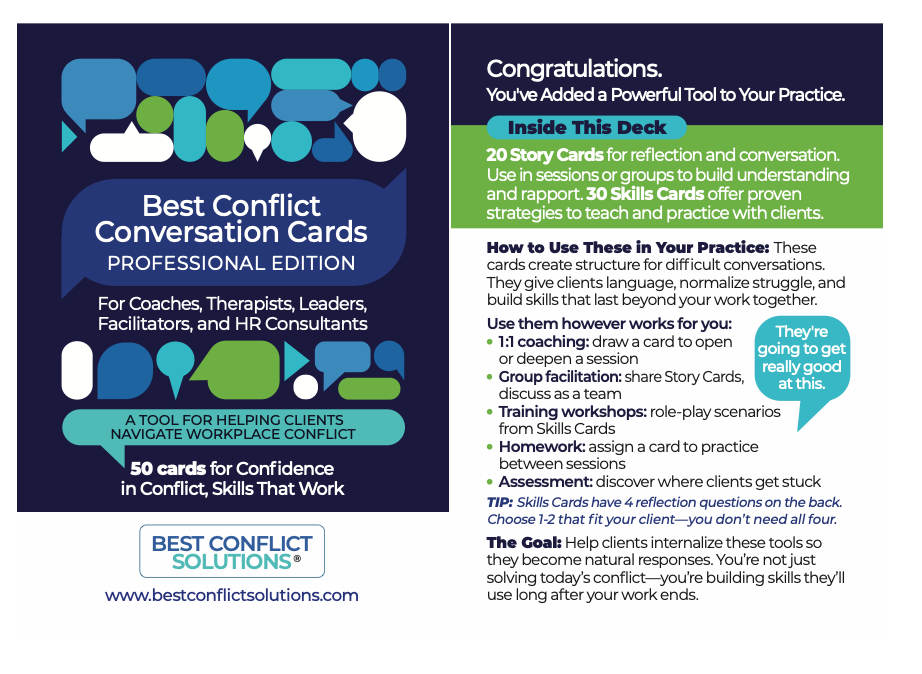
The Best Conflict Conversation Cards: Professional Edition is here. I got feedback from the Workplace Edition Cards and also the brilliant invitation to create a deck for career coaches, social workers, EAP counselors, HR consultants, L&D professionals, mediators and conflict resolution professionals, workshop facilitators, and retreat leaders. These cards give teams and individuals a practical way to build conflict skills, one conversation at a time.
Here's what people are saying:
"I just opened the package and devoured the cards. They are magnificent and an incredible tool. Thank you thank you thank you for creating them. Far from having too high expectations, these exceeded my already high expectations. An incredible tool for the field!" — Dr. Melinda Burrell, melindaburrell.com
"I recently used Kim Best’s Best Conversation Cards during a brand strategy workshop with a growing company, and they were incredibly effective. The prompts helped people articulate what they were really thinking, listen more closely to one another, and move past surface-level disagreement. What could have stalled the workshop instead turned into a productive, clarifying conversation that led to real resolution and alignment." Murphy Funkhouser, murphy@brandstageconsulting.com
I'll be presenting at National SHRM 2026. I'm leading a pre-conference workshop on workplace conflict:
Session 705: From Fixer to Facilitator: Mediation Skills Every HR Professional Can Use Monday, June 15, 2026, 1:00pm – 5:00pm
I'm so excited about this workshop! It's not a one-hour seed planting. It's enough time for participants to learn tools they can really use. And I got a whole lot more excited when I learned Oprah is going to be speaking at the conference too!
Upcoming Training: Conflict Resolution and Clinical-Setting Mediation for Healthcare
This course is almost sold out! This training is online for 4 days, with limited enrollment to ensure a fully intimate and engaging experience. Led by Haavi Morreim, PHD, JD, this program is always a hit!
Dates: Tuesday February 23 - Friday February 26, 2026
Tuition: $950.00
For additional course description and registration see:
An article I wrote was published in the Australasian Dispute Resolution Journal:
“CONFLICT COACHING AS WORKFORCE RETENTION INFRASTRUCTURE IN HEALTH CARE”(Final version published as: Best K, "Conflict Coaching as Workforce Retention Infrastructure in Health Care" (2025) 34 Australasian Dispute Resolution Journal 49)
I was invited by Dr. Samantha Hardy to write about dispute resolution coaching for healthcare employees. The article explores how conflict coaching can serve as workforce retention infrastructure in healthcare settings, a topic close to my heart. You can find the Author's Accepted Manuscript on my website.
Now, the thing I've been thinking about: The Personal Cost of Conflict
I've been doing a lot of writing lately on the cost of conflict. In healthcare. In workplaces. In families. And the statistics are alarming.
Workplace conflict costs U.S. businesses an estimated $359 billion annually. Employees spend nearly three hours every week navigating tension instead of doing their jobs.
In healthcare, the average hospital has turned over more than 100% of its staff in the past five years. Every nurse who leaves costs roughly $61,000 to replace. And the Joint Commission tells us that communication failures underlie 70% of sentinel events, the most serious safety incidents in medicine.
At home, forty-two million Americans are caring for aging loved ones, and in 43% of those families, one sibling shoulders most or all of the responsibility. Thirty-eight percent of American adults are currently estranged from at least one close family member. The average contested divorce costs $15,000 or more, but the real price isn't financial. It's the fractured relationships, the years of tension, the toll on children who grow up learning that conflict means silence or war. These patterns don't stay in one generation. They echo forward.
Those are staggering numbers. And yet, every time I write them, something nags at me.
Does the money really matter the most?
We spend a third of our lives at work. We spend our whole lives in families. These relationships aren't line items. They're where we find meaning, build identity, and become who we are. So what about the cost to that? The cost to quality of life. To personhood. To the relationships that make everything else worthwhile.
Today I want to talk about the personal costs. And about what we can actually do.
You're Not Alone. And Neither Is the Person You're in Conflict With.
The tension you're carrying from that conversation with your boss? It follows you to the dinner table. The years of unspoken hurt with your sibling? They shape how you respond when a colleague disagrees with you. The argument with your partner this morning? It's sitting in your chest during that afternoon meeting. The stress of navigating your parent's care with siblings who won't help, or who second-guess every decision you make? It's draining energy you need everywhere else.
These aren't separate problems. They're the same problem showing up in different relationships.
And we're not handling any of it well.
More than half of people dealing with workplace conflict report significant stress. Fifty-six percent report anxiety or depression. Family estrangements don't happen overnight. They build, conversation by avoided conversation, until the distance becomes permanent. Healthcare teams fracture under tension they never learned to address, and patients pay the price. Siblings who once shared a childhood stop speaking over decisions about Mom's care.
This is your sleep. Your health. Your sense of who you are when things get hard.
I've been there. Most of us have.
But here's what I want you to consider.
The person on the other side of that conflict? Whether it's your manager, your mother, your sibling, your colleague, or your business partner... they're probably not sleeping well either.
They're juggling things you can't see. Stress you don't know about. A story that makes complete sense to them, just like your story makes complete sense to you. They're not showing up as their best self. Just like you might not be showing up as yours.
You're both carrying something. You're both doing the best you can with what you have. And you're both wishing it were easier.
This doesn't excuse bad behavior. It doesn't mean you have to accept mistreatment. But it does open a door.
Because most conflict isn't a character problem. It's a skills gap.
People genuinely want harmony, not drama. At work, at home, in the relationships that matter most. But when tension rises, most of us were never taught what to do. We avoid, or we escalate, or we shut down. Not because we're broken, but because no one ever gave us better tools.
That's actually good news. Skills can be learned.
And here's the thing: they transfer.
The skill you build having a hard conversation with a coworker? It helps you navigate the one you've been avoiding with your adult child. The ability to stay grounded when your sibling pushes your buttons? It serves you in that meeting with your difficult client. What you learn mediating your parents' care decisions helps you lead through conflict at work. Learning to name what's happening without blame changes how you show up everywhere. At work, at home, in every relationship that matters.
Do it for you.
Not for the organization's bottom line. Not because someone told you to. Do it because you deserve better outcomes, better relationships, a deeper sense of your own ability to show up when things get hard.
Do it because the conflict you're carrying doesn't have to stay stuck. Not the tension at work. Not the silence at home. Not the relationship you've almost given up on.
You can learn to listen in a way that lowers defenses instead of raising them. To say the hard thing with clarity andcompassion. To stay true to who you're proud to be, even on the hardest days.
And you don't have to figure it out alone.
Whether it's coaching to prepare for a difficult conversation, mediation to work through something that's gotten stuck, or simply a space to think out loud with someone who's seen this before... support exists.
The conflict you're carrying right now? You have better options than pretending it isn't there or trying to win. There's a way forward that lets you live your values, even when it's hard.
That's what I help people do.
If you're navigating something hard right now, at work, at home, or somewhere in between, I'm here. Based in St. Louis, Missouri and working nationwide.
Kim
Kimberly Best, RN, MA Mediator | Trainer | Conflict Coach | Best Conflict Solutions "The most important conversations are often the ones we're not having."


Comments