
Why Healthcare Teams Should Practice Difficult Conversations

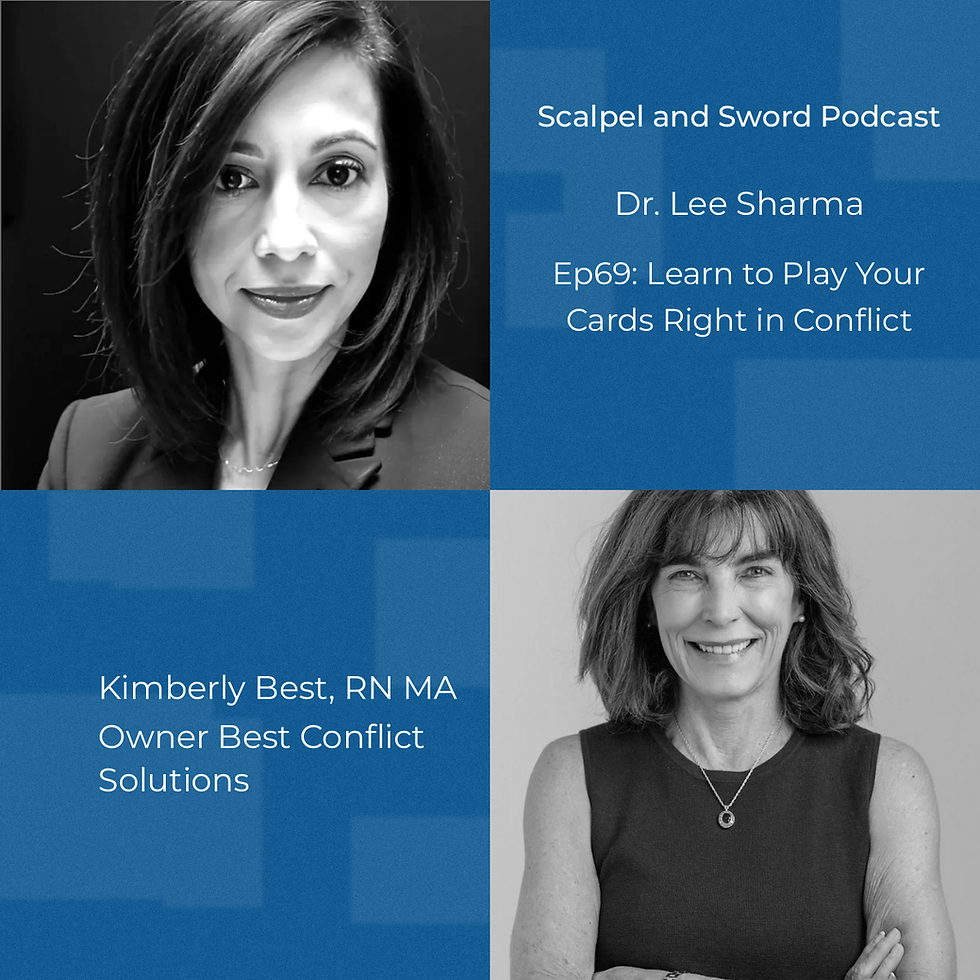
I had the pleasure of returning as a guest on Scalpel and Sword this month with Dr. Lee Sharma. Dr. Sharma is a physician and conflict analyst who is doing something genuinely difficult: making conflict a subject that doctors are allowed to talk about out loud. Every conversation with her sharpens my own thinking.
She opened this one with a question I keep coming back to. In medicine, we practice everything. Knot tying, codes, deliveries, C-sections. We know the reps are what make us good. So why don't we practice conflict?
We simulate every other high-stakes moment in healthcare. We don't simulate the hard conversation.
That gap is the whole reason I created the Best Conflict Conversation Cards. Lee and I spent Ep69 on the cards, how people are using them, and why a difficult conversation deserves the same rehearsal as any procedure.
Listeners get 10% off the Best Conflict Conversation Cards with code PODCAST10 at checkout. Shipping is free in the US and Canada, as always.
Why conflict training doesn't stick for healthcare teams
Lee named something I hear constantly. You attend a webinar, the ideas land, and the next morning you're in the middle of a conflict and can't recall a single one.
Conflict skills for healthcare teams are procedural, not conceptual. Understanding a technique and being able to run it while your pulse is up are two different capabilities, and only one of them is built by listening. That's the gap the cards were designed for: one skill on the front, a short set of questions on the back, small enough to carry in a pocket. You can practice one alone and nobody needs to know, or a team can work one card a week and build the toolbox together.
What "the story I'm telling myself" does in a conversation
"The story I'm telling myself" is a phrase you put in front of your own interpretation of someone's behavior, so that you name the conclusion you've drawn instead of stating it as fact. I learned it from the work of Brene Brown, and it has become the technique my clients use most.
Lee and I walked through a scenario every attending and resident will recognize. Coming out of a difficult case, the attending says, "You need to work on how you communicate with the nursing staff." The resident fires back, "They don't respect residents. I'm always the one getting blamed."
Now watch it with the phrase in front:
"The story I'm telling myself is that when you interact with the nurses, you may not see them as part of your team. What's going on?"
Nothing has been softened. The concern is still on the table. What changed is that the attending owned the interpretation and left room for another one. The resident hears concern for the patient and the team rather than an attack, and the conversation has somewhere to go.
In the absence of information, we are wired to make up a story, and the story becomes the truth whether it's accurate or not. This phrase interrupts that. It also does something for the person saying it: the story you're telling yourself reveals more about your own fears and assumptions than about the other person's intentions.
There are rarely difficult people, only skills gaps
I rarely meet a difficult person. I meet people stuck in a conflict without the tools to move through it.
All of us are difficult when we're in conflict. Shutting down and walking away is difficult too, if you're the one left wanting to finish the conversation. What gets labeled a people problem in a hospital department is usually a skills gap, and skills gaps are fixable in a way that personalities are not. Once a team stops sorting itself into the difficult doctor, the difficult nurse, and the difficult patient, it can start naming the actual problem that needs solving. You can't solve for people. You can solve for problems.
The card I'm most attached to
Card number one in the deck reads: just because I don't agree with you doesn't mean I'm against you. It means I'm different than you.
Disagreement gets read as enmity right now, in hospitals and everywhere else. That sentence does a lot of work. When you get curious about the person who sees it differently, you usually find more common ground than you expected.
Lee said one more thing worth sitting with. Having a tool makes you curious, and curiosity leads to mastery. Once you stop being afraid of the conversation, you start noticing opportunities to practice everywhere.
One thing to try this week
The next time you're certain you know what someone meant, say it out loud with those words in front of it: "The story I'm telling myself is..." Then stop and let them answer. It costs nothing, and I have yet to see it make a conversation worse.
Frequently asked questions
How do you practice conflict resolution skills at work?
Practice one skill at a time in low-stakes moments rather than waiting for a crisis. Pick a single technique, use it deliberately for a week, and reflect afterward on what changed. Teams can do this together by working through one skill per meeting. Practicing when the stakes are low is what makes the skill available when they're high.
Why do healthcare workers avoid conflict?
What is "the story I'm telling myself"?
Are conflict conversation cards the same as icebreakers?
Listen and get the cards
Listen to Ep69, Learn to Play Your Cards Right in Conflict, on Apple Podcasts.
The Best Conflict Conversation Cards, Workplace Edition, are $49. Use code PODCAST10 for 10% off, and shipping is always free in the US and Canada.
If you're planning leadership training or a workshop, a residency session, or a team retreat and want to talk about using the deck with a group, reach out. I'd love to hear how you're putting the cards to work. You can also read more about my healthcare conflict work or schedule a free discovery call.
My thanks to Lee for the conversation, and for the work she's doing at rleesharma.com to make conflict a subject physicians are allowed to talk about.
Kimberly Best, RN, MA, is a court-listed mediator in Missouri and Tennessee, a FINRA arbitrator, and an adjunct professor at the Lipscomb University Institute for Conflict Management. She founded Best Conflict Solutions in St. Louis and works with healthcare organizations, businesses, and families nationwide.


Comments